StandFinder Field Notes
Water management strategies for sustainable farming
Conserve water and support healthy crops with better irrigation choices, soil-moisture monitoring, mulch, rainwater collection, maintenance, and season-aware planning.
In this guide · 16 sections
Farm water management is not simply the choice between drip line and sprinklers. It is the coordinated work of protecting the source, building soil that accepts water, delivering the right amount to the root zone, monitoring crop response, maintaining equipment, and planning for dry and wet extremes.
A farm can use an efficient irrigation technology inefficiently. A buried leak, clogged filter, oversized zone, bare soil, or fixed timer can waste water while crops remain stressed. The strongest plan begins with a map and measurements, then improves the system one constraint at a time.
Create a farm water map
Draw every source, storage point, pump, filter, mainline, valve, hydrant, zone, drain, field, wash area, roof, ditch, waterway, wet spot, and erosion path. Add pipe sizes, elevations, pressure regulators, and equipment flow requirements when known.
Mark which water is used for irrigation, handwashing, produce washing, animals, household needs, frost protection, mixing, and fire response. These uses may have different quality, treatment, availability, and regulatory requirements. Never assume an irrigation source is suitable for postharvest use.
Walk the map after rain and during irrigation. Photograph ponding, runoff, broken connections, wet pressure zones, and dry ends. A simple map often reveals that the first investment should be a valve, filter, or drainage repair rather than a larger pump.
Build a seasonal water budget
A water budget compares expected demand with reliable supply. Estimate irrigated area, crop water needs across growth stages, system efficiency, peak weekly demand, other farm uses, storage, pump capacity, and source limitations.
Use local evapotranspiration information, weather, soil, and crop guidance when available. Convert the result into units your system can measure, such as gallons per zone or inches applied. Confirm the estimate with actual flow.
Measure source recovery and legal withdrawal limits. A pond full in spring may not remain usable in August. A well's pump rating does not tell you its sustainable yield. Surface-water rights, permits, reporting, storage, and stream protections vary by location; verify them with the appropriate agencies.
Plan for the peak, but also plan how to reduce it. Staggering plantings, grouping crops by need, improving soil cover, fixing leaks, and choosing drought-tolerant crops can be less expensive than expanding supply.
Test water quality for the intended use
Water quality affects people, crops, soil, equipment, and food safety. Test sources according to their use and risk. Relevant measures may include microbial indicators, pH, alkalinity, salts, sodium, chloride, iron, sediment, and specific contaminants associated with the site.
Surface water can change after storms, animal activity, or upstream events. Well quality can change with flooding, construction, or aquifer conditions. Keep wells protected, inspect caps and drainage, prevent backflow, and follow a sampling schedule appropriate to the operation.
Food-safety requirements for agricultural water continue to evolve and can depend on crop and activity. Obtain current guidance for harvest and postharvest uses. A filter that protects drip emitters is not automatically a treatment that makes water safe for washing produce.
Make the soil receive water
Irrigation cannot correct soil that sheds water, seals at the surface, or has a compacted layer roots cannot cross. Evaluate infiltration, aggregation, crusting, compaction, rooting depth, residue, slope, and organic matter.
Protect the surface with growing crops, cover crops, residue, or appropriate mulch. Living roots and organic inputs can improve structure over time. Minimize traffic on wet soil and create permanent lanes where the system allows. Address a compacted layer based on diagnosis, then change the traffic or tillage pattern that created it.
Contour beds, grassed waterways, terraces, or other erosion controls may slow runoff on sloping land when professionally and locally designed. Do not redirect water toward neighbors, roads, buildings, wells, septic systems, or unstable areas.
An infiltration test at representative locations can track direction, but one number does not describe the whole field. Repeat under similar moisture and management conditions.
Match the irrigation method to the crop
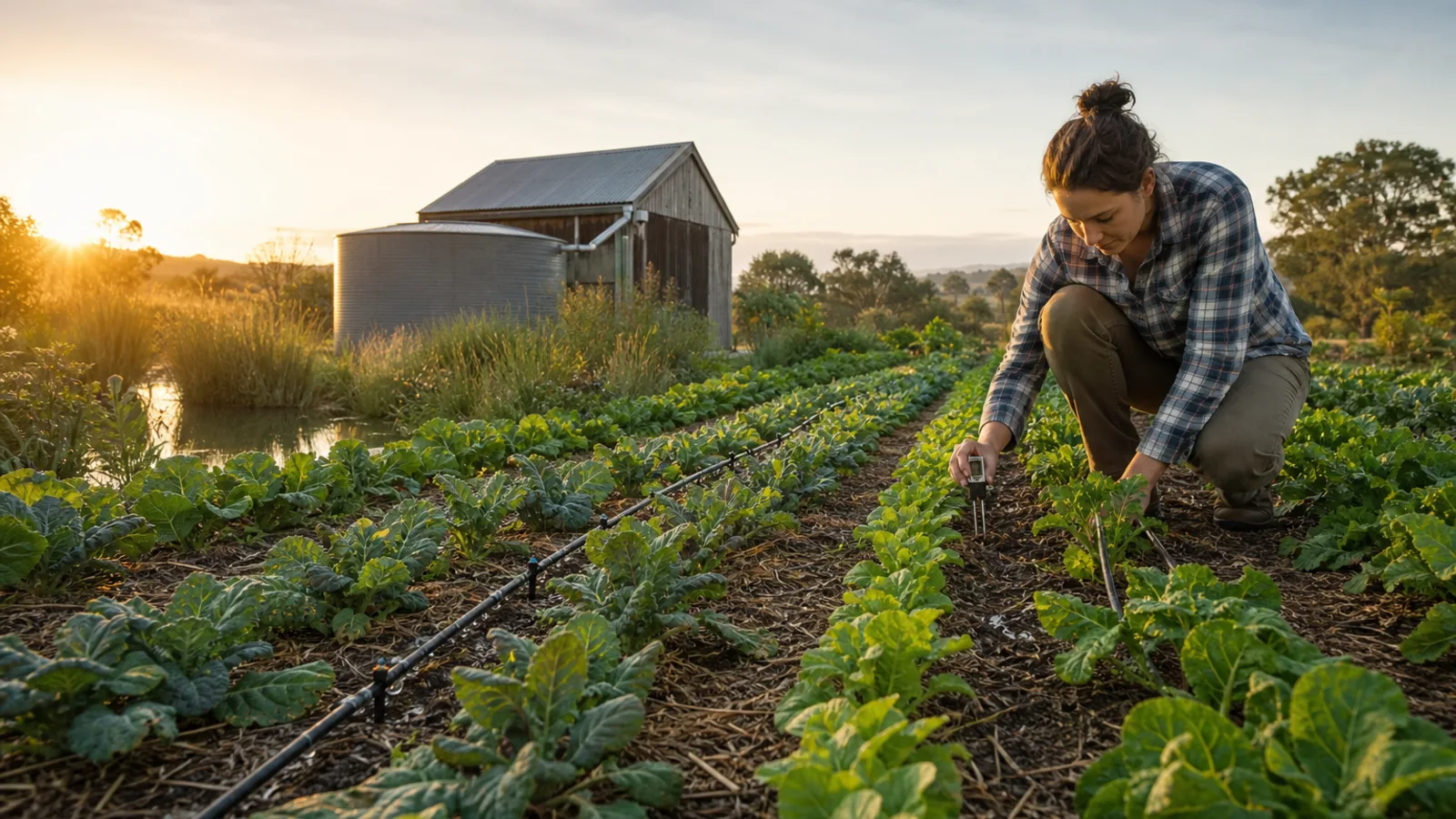
Drip irrigation places water near the root zone, reduces leaf wetness, and works well with zones. It requires filtration, pressure management, inspection, disposal or reuse planning, and care around rodents and cultivation.
Overhead irrigation can establish direct-seeded crops, cool certain crops, provide broad coverage, and serve frost protection in specialized systems. Wind, evaporation, runoff, disease, uneven distribution, and energy must be managed.
Micro-sprinklers may suit orchards, berries, or specific beds but share some overhead limitations.
Furrow or surface irrigation can work where land shaping, soils, water rights, and management support it. Poorly controlled systems can create deep percolation, erosion, or uneven application.
Hand watering is flexible for small areas and transplants but difficult to measure and labor intensive. Use flow meters or timed known-flow devices to make it less subjective.
The best farm may use several methods. Choose by crop stage, field shape, water quality, pressure, labor, energy, disease, and the need to move equipment.
Design drip irrigation as a hydraulic system
Drip line does not distribute evenly just because it looks straight. Pressure changes with elevation, pipe friction, zone length, and flow. Emitters have operating ranges, and long runs can leave the far end dry.
Size mains, submains, zones, filters, regulators, and valves with qualified guidance and manufacturer information. Use pressure gauges at useful points. Measure discharge from emitters near the beginning and end of representative lines.
Divide zones so crops with similar need and planting date run together. A mature tomato block should not share an inseparable schedule with newly seeded carrots. Label valves and map repairs.
Install backflow prevention where required and protect chemical or fertilizer injection systems with appropriate safeguards. Flush lines to a managed location, not into a waterway. Check for leaks while the system is pressurized and repair them promptly.
Schedule from the root zone, not the clock
A timer is a tool, not a crop sensor. Schedule irrigation using crop stage, effective root depth, soil texture, recent rainfall, forecast, canopy, mulch, and observed soil moisture.
Check moisture at multiple depths with a trowel, auger, tensiometer, capacitance sensor, or other suitable method. A damp surface can hide a dry root zone; a dry surface can sit above adequate moisture. Learn how the field feels before and after a known application.
Young plants need a smaller, accessible wetted zone. Established crops can often use deeper, less frequent watering if the soil and roots allow it. Excess short cycles may keep roots shallow and lose water to evaporation, while overly long cycles may move water below roots or cause runoff.
Irrigate at times that reduce wind and evaporation while fitting labor, disease, frost, energy rates, and system capacity. Early morning is often useful, but there is no universal hour for every method and climate.
Record run time, estimated volume, rainfall, moisture reading, and crop condition. Adjust when weather changes rather than repeating last week's schedule.
Use mulch with a plan
Organic mulch can reduce evaporation, suppress weeds, soften rainfall, and moderate soil temperature. It can also tie up surface nitrogen as it decomposes, cool spring soil, interfere with direct seeding, shelter rodents or slugs, and introduce weed seed or contaminants.
Plastic mulch can warm soil, suppress weeds, and manage moisture but requires installation, removal, disposal, and microplastic awareness. Biodegradable products must meet relevant performance, certification, and local requirements; “biodegradable” on a label does not automatically mean approved for soil incorporation or organic production.
Match material and depth to the crop and season. Keep mulch from direct contact with vulnerable stems and crowns. Inspect beneath it instead of assuming soil moisture is uniform.
Weed control is also water management. Large weeds can remove significant water and make moisture readings misleading. Control them before they compete with the crop.
Choose crops and varieties for the water reality
Crop selection can reduce risk before irrigation begins. Match season length, rooting, heat tolerance, maturity, and market window to the available supply.
Short-season varieties may finish before the driest period. Some varieties maintain quality under heat or irregular rain better than others. Deep-rooted established perennials can access more soil volume, but they may still require substantial water during establishment or fruit fill.
Prioritize water when supply is limited. Young trees, high-value transplants, and crops at critical reproductive stages may deserve protection before a low-value block near the end of harvest. Decide the priority before a restriction.
Do not overplant based on an optimistic spring source. Include irrigation capacity in the crop plan and leave a margin for equipment failure and extreme heat.
Capture rain where it makes sense
Roof runoff can supplement irrigation, livestock, cleaning, or emergency uses depending on design, water quality, treatment, and law. Calculate collection potential from roof area and local rainfall, then compare it with demand.
Storage is often the limiting cost. Include a screened inlet, first-flush or debris management where appropriate, opaque and secured storage, overflow routed safely, freeze protection, foundation, pump, treatment, and maintenance access. Prevent mosquito breeding and child access.
Never connect nonpotable and potable systems in a way that permits cross-connection. Label outlets and train workers.
Landscape water harvesting—such as swales, berms, contour plantings, and infiltration basins—must reflect slope, soil, geology, overflow, and neighboring property. Poor design can saturate foundations, trigger erosion, or concentrate contaminants. Seek qualified site-specific guidance for earthworks.
Manage too much water as seriously as drought
Heavy rain can erode soil, drown roots, spread disease, contaminate fields, delay work, and damage access. Identify where water enters and leaves production areas.
Maintain vegetated buffers and waterways where appropriate. Keep culverts, ditches, and drains functional and legally compliant. Avoid leaving loose soil before forecast storms. Use cover crops and residue to protect the surface.
After flooding, water contact may create food-safety risks that ordinary washing cannot correct. Isolate affected crops and obtain current regulatory or Extension guidance before harvest. Document the extent and source of water.
Do not move sediment or drainage problems downstream. Watershed-scale problems require coordination with conservation professionals, neighbors, and agencies.
Prevent irrigation from becoming a food-safety problem
Keep animals, manure, compost leachate, chemical mixing, and fuel away from water sources and conveyance. Protect hose ends from soil and standing water. Use backflow prevention. Store and handle fittings cleanly for their intended use.
Consider the edible portion and timing. Overhead water contacting ready-to-harvest leafy greens presents a different exposure than drip beneath a non-edible orchard floor. Use current agricultural-water standards and a farm food-safety plan.
Train workers to report broken pipes, cross-connections, unusual odors, dead animals near a source, flooded wells, or water that changes color. Stop and evaluate rather than continuing because harvest is scheduled.
Maintain the system before peak demand
Before the season:
- Service pumps and verify electrical safety
- Test flow and pressure
- Clean or replace filters
- Inspect regulators, valves, hydrants, and backflow devices
- Flush lines
- Repair leaks and rodent damage
- Calibrate injectors and meters
- Stock critical fittings
- Confirm backup power or failure procedures where needed
During the season, walk one zone while it operates each week. Look for geysers, puddles, dry plants, clogged emitters, shifted sprinklers, pressure changes, and filter differential. Check the far end, not only the valve.
At shutdown, drain and winterize according to climate and equipment. Store reusable components away from sunlight and pests. Update the map with repairs before memory fades.
Compare conservation projects financially
Calculate installation, maintenance, labor, energy, useful life, financing, and disposal. Estimate water saved from measurements, not a generic percentage.
A repair with a low upfront cost may outrank an automated controller. Soil improvements may reduce water demand while also helping erosion and crop health, but benefits take time. A tank may add resilience without paying back solely through water price.
Include risk reduction. Reliable irrigation during a short critical window may protect a high-value crop even if annual average savings appear small. State assumptions and test them after installation.
Build a 30-day water reset
Week one: map sources, zones, uses, and drainage. Read meters or measure flow. Identify leaks and dry areas.
Week two: repair obvious losses, service filters and regulators, label valves, and compare output at the beginning and end of lines.
Week three: establish soil-moisture checks in representative fields. Match zones to crops and adjust one schedule based on readings and weather.
Week four: create a seasonal water budget, drought priority list, water-quality testing calendar, maintenance checklist, and one improvement project with a measurable outcome.
Repeat measurements after the change. Water savings that exist only in an equipment brochure do not support farm decisions.
Measure resilience, not just gallons
Track water used by block or crop when possible, irrigation hours, pump energy, leaks, repairs, rainfall, soil moisture, yield, quality, and crop loss. Compare water use with marketable output while watching for stress.
Lower use is not automatically better. Underwatering can reduce yield and waste every other input already invested. The goal is to deliver sufficient clean water with less avoidable loss and stronger capacity for extremes.
Water management connects to soil, crop choice, food safety, energy, labor, and community watersheds. Add it to a broader sustainable farming plan, compare local experience in the StandFinder community, and describe verified conservation practices clearly when shoppers ask. Every repaired leak and well-timed irrigation is small, but together they build a farm better prepared for the next dry week and the next hard rain.