StandFinder Field Notes
Preparing your farmstand for the holiday season
Prepare for holiday shoppers with an organized product plan, attractive gift options, seasonal displays, clear promotion, reliable inventory, special events, and thoughtful customer service.
In this guide · 19 sections
The holiday season can extend farmstand income beyond the main harvest and give customers a meaningful alternative to generic gifts. It can also create a stressful mix of perishable inventory, handmade products, winter weather, shipping expectations, and last-minute requests.
The solution is to plan backward. Choose a small collection the farm can produce legally and consistently, calculate each item's true cost, open preorders early, and design pickup so the final week feels like fulfillment rather than improvisation.
“Holiday” should fit the community. Some customers celebrate Christmas, Hanukkah, Kwanzaa, winter solstice, New Year, other traditions, or no religious holiday. A warm seasonal farmstand can welcome all of them without flattening every occasion into one theme.
Set the season's goal and limits
Decide what the holiday program should achieve: sell storage crops, create gifts from existing products, bring customers back in winter, support partner producers, or generate a specific level of profitable sales.
Set limits at the same time:
- Dates and hours the stand can reliably operate
- Order volume the team can pack
- Products that can be stored safely
- Budget for packaging and display
- Parking and indoor capacity
- Final preorder and pickup dates
- Whether shipping or delivery is truly manageable
It is better to offer 40 excellent baskets with reliable pickup than accept 100 custom orders the team cannot finish. Capacity limits also protect regular customers who still need ordinary food during the gift rush.
Work backward on a 12-week calendar
Twelve to ten weeks before the main holiday: review last year's records, select products, confirm rules, contact partners, price packaging, and estimate capacity.
Nine to seven weeks before: order nonperishable supplies, photograph sample products, build the order form, test payment, and schedule staff.
Six to four weeks before: announce the collection, open preorders, prepare shelf-stable inventory, cure and inspect storage crops, and confirm partner deliveries.
Three to two weeks before: close custom options, check packaging counts, send pickup reminders, create packing stations, and test the customer traffic flow.
Final week: assemble in batches, verify every order, protect perishables, stage pickups by time, update public inventory, and keep a weather plan active.
After the season: reconcile inventory and payments, follow up on problems, thank customers and partners, and record changes before packing supplies away.
Move dates for local celebrations and the products you sell. The discipline is working backward from pickup, not copying exact weeks.
Choose products for quality and reliability
Begin with products the farm already grows or makes well. Holiday demand does not improve a marginal recipe or a damaged storage crop.
Potential categories include:
- Apples, pears, citrus, nuts, or other locally suitable fruit
- Winter squash, potatoes, sweet potatoes, onions, garlic, carrots, cabbage, and roots
- Honey, maple products, eggs, bread, preserves, sauces, dried herbs, tea blends, or baked goods where legally produced
- Dried flowers, wreaths, greenery, candles, wool, soap, or crafts from appropriate local producers
- Gift cards, future-season credits, memberships, or event reservations with clear terms
- Recipe bundles, breakfast boxes, soup kits, and preserving sets
Evaluate shelf life, allergen information, labeling, cold holding, breakage, moisture, and how the item looks after several days in a basket. Avoid fragile products that require perfect handling if customers will travel.
Do not turn seconds into gifts unless their condition is appropriate and clearly represented. Holiday packaging increases expectations.
Verify value-added food rules early
Jams, pickles, baked goods, sauces, dried foods, meat, dairy, eggs, sampling, and repacking may be regulated differently by product and location. Cottage-food allowances are specific and often limit ingredients, sales channels, labels, revenue, or shipping.
Contact the relevant agriculture or health authority before advertising. Confirm production facility, process approval, licenses, inspection, allergen declarations, ingredient lists, net quantity, dates, storage, and sales channels.
If a partner makes the item, retain invoices and accurate producer information. Do not relabel it as the farm's own unless that arrangement and label are lawful and truthful. Insurance should reflect the products and events offered.
This guide is operational planning, not legal or food-safety advice. Current local requirements control.
Design a focused holiday collection
Too many options create purchasing, photography, packing, and checkout errors. Build a small “good, better, best” collection with clear differences.
For example:
- Small seasonal thank-you: honey, apples, and dried herbs
- Farm breakfast box: eggs, bread, jam, and maple syrup where available
- Winter kitchen basket: squash, onions, garlic, beans, herbs, and a soup card
- Premium local pantry: a curated mix of farm and partner products
Offer one or two add-ons rather than unlimited substitutions. Let customers choose an allergy-safe or nonfood alternative only if the workflow can prevent cross-contact and fulfill it accurately.
Give every collection a complete contents list, approximate size, storage information, pickup date, substitution policy, and price. Photograph the actual scale. Props that are not included should be visibly separate or identified.
Calculate gift pricing from the packed item
Include product cost, partner wholesale cost, basket or box, filler, tissue, ribbon, card, label, assembly labor, order processing, payment fees, storage loss, breakage, and a share of seasonal promotion and overhead.
Packaging can quietly consume the margin. Price a fully assembled sample before announcing the collection. Time one careful assembly and include realistic labor, not the optimistic pace after making ten.
Bundles can provide value without a discount. Customers pay for curation, presentation, and convenient pickup as well as the products. If you do discount, show that the final contribution still supports the farm.
Require deposits or full prepayment for custom or limited orders where appropriate. Publish cancellation, missed-pickup, refund, and crop-failure terms in plain language.
Buy packaging that protects the product
Choose containers based on weight, moisture, ventilation, stackability, carrying, and reuse—not only appearance. A shallow basket may display apples beautifully but fail under jars and squash.
Use food-safe contact materials where required. Keep evergreen sap, loose dried plants, fragrance, soil, and nonfood crafts from contacting unwrapped food. Prevent glass jars from striking one another. Do not enclose warm bread in a way that traps condensation.
Standardize a few box sizes and keep a packing diagram or sample at the station. Order a sensible buffer, then count supplies weekly. Save clean, reusable display materials for next year and avoid personalized packaging that becomes waste if an order changes.
Offer low-waste choices such as reusable crates, simple kraft boxes, cloth ties, or bring-back baskets when the system can track and clean them. Do not make environmental claims without understanding the material's actual disposal path.
Create an assembly line with quality checks
Separate product storage, packaging, assembly, finished-order staging, and customer pickup. Keep food at required temperatures throughout the process.
A practical sequence is:
- Print or display the order list without exposing customer data unnecessarily.
- Pick the correct container and add structural packing.
- Add heavy, stable products first.
- Add fragile or perishable items at the appropriate time.
- Verify contents against the order.
- Add approved card and care instructions.
- Label with customer name or code and pickup window.
- Move to the correct temperature-controlled staging area.
- Mark the order complete only after verification.
Use a second-person check for high-value or custom orders. Count finished orders against payments each day. Keep customer contact details secure and destroy unnecessary working copies.
Use preorders to make demand visible
Preorders reduce inventory guesswork and make pickup faster. The ordering page should show photos, contents, allergens where relevant, price, tax, pickup location, pickup windows, capacity, substitution rules, contact method, and cancellation terms.
Set inventory limits by the scarcest component. If only 30 jars of a preserve exist, do not accept 50 baskets that require it unless an approved substitution is clear.
Close orders early enough to buy, harvest, pack, and correct errors. Send confirmation immediately and a reminder shortly before pickup. Provide a way to report a missing confirmation without inviting changes by scattered messages across multiple platforms.
For phone or in-person orders, enter them into the same system. Separate notebooks create duplicate and forgotten orders.
Keep the everyday stand easy to shop
Not everyone wants a gift. Maintain a straightforward area for eggs, roots, greens, apples, bread, or other weekly staples. Avoid making regular customers wait behind complex custom orders.
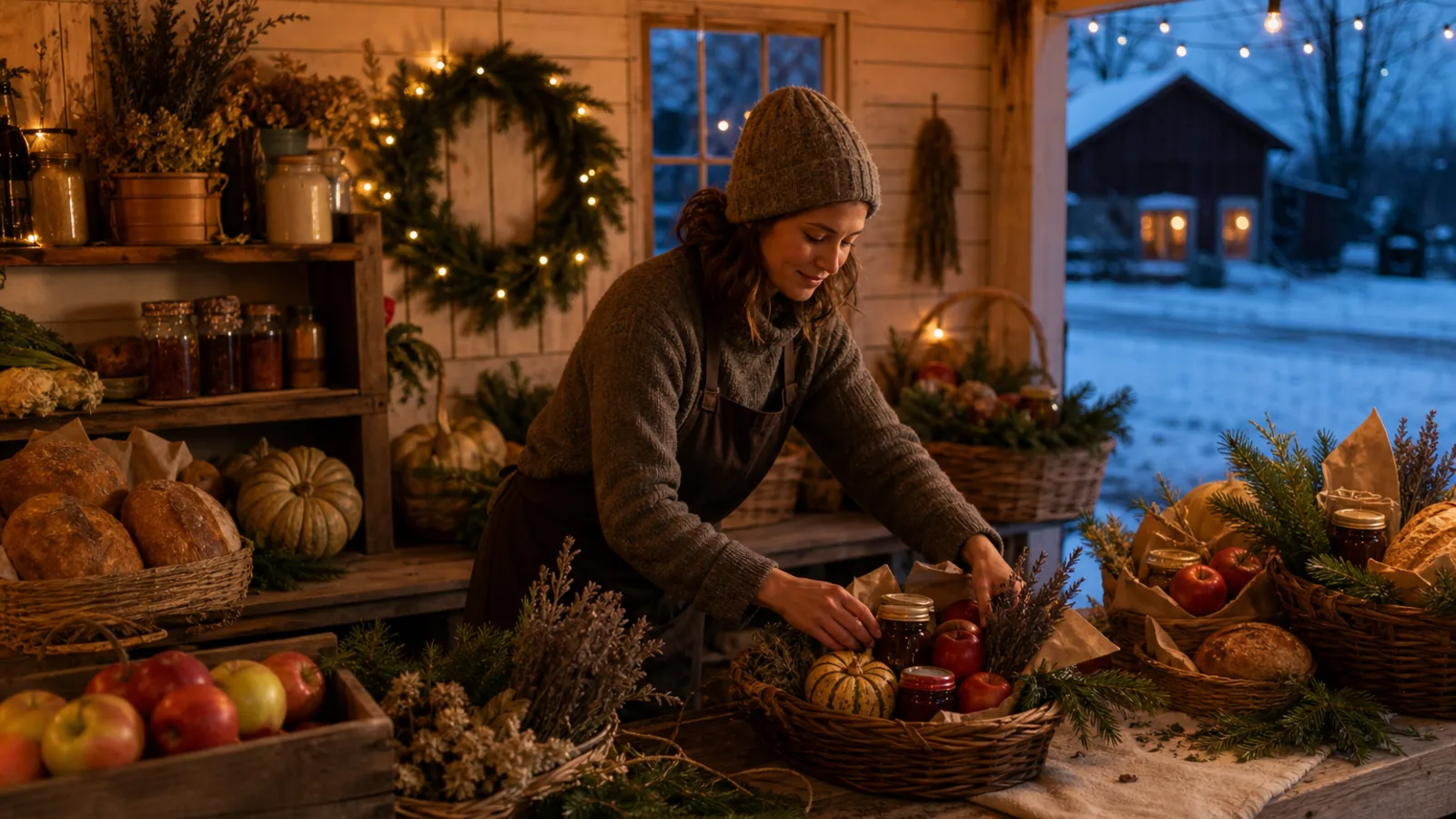
Display holiday collections at several price points, but leave walking and checkout space. Use sturdy risers, warm lighting, natural seasonal materials, and clear signs. Secure decor against wind and keep dried plants, candles, cords, and heaters away from ignition or food-safety hazards.
Represent traditions respectfully. Generic winter textures, local greenery, harvest colors, and customer-chosen cards can feel seasonal without assuming everyone celebrates the same way.
Remove sold-out samples or mark them immediately. A beautiful display of unavailable products causes frustration.
Plan pickup like a small fulfillment operation
Assign pickup windows based on parking, staff, cooler space, and average handoff time. Stage orders alphabetically or by time, but avoid exposing customer names to everyone.
Create a separate express area for prepaid orders if the site allows. Confirm the order identifier, retrieve the package, review perishable storage, and mark pickup complete. Do not leave food or customer information unattended outdoors unless the system is designed and permitted for it.
Have a missed-pickup procedure. Specify how long perishables can be held, whether another person may collect the order, and what happens after the final date. Contact customers promptly, but do not promise indefinite storage.
For curbside service, mark the safe stopping point and keep staff out of moving traffic. Do not create backups on a public road.
Prepare for winter weather and power loss
Snow, ice, wind, rain, freezing temperatures, and early darkness affect the stand even when every product is shelf stable. Maintain walkways, drainage, lighting, handrails, parking, and entry mats. Anchor decor and signs.
Monitor indoor and cooler temperatures. Protect water lines and payment equipment. Keep a power-outage plan for refrigeration, lighting, doors, and customer communication. Know which products must be moved or discarded and who makes that decision.
Publish a clear weather policy before a storm. If pickup moves, communicate the new date, time, and action required through the same channels used for ordering. Update the StandFinder listing so ordinary visitors do not arrive at a closed site.
Worker safety outranks a pickup promise. Do not require travel or outdoor setup in unsafe conditions.
Market with useful information
Begin promotion with existing customers who already know the farm. Show the real contents, tell the source of partner goods, explain preorder dates, and demonstrate scale. A short video of packing can answer more questions than a heavily styled image.
Create a rhythm:
- Collection announcement
- One post about each product's use or maker
- Capacity or deadline reminder
- Pickup instructions
- Sold-out or walk-in inventory update
- Thank-you and storage tips
Avoid daily urgency claims unless inventory is genuinely limited. False countdowns damage trust. Do not advertise shipping if packaging, carrier rules, food law, cost, and delivery timing have not been tested.
Gift cards and future credits bring cash earlier but create a liability. Use clear expiration and redemption terms that comply with law, record balances, and reserve capacity for redemption.
Create small experiences without overwhelming operations
A tasting, wreath demonstration, recipe pickup, lantern evening, or partner pop-up can make the season memorable. Give each event a purpose and capacity.
Confirm fire safety, sampling and food rules, parking, accessibility, insurance, restrooms, handwashing, staffing, animals, heaters, weather, and crowd flow. Use reservations for limited workshops and publish what the ticket includes.
Schedule experiences away from the peak pickup bottleneck. A musician beside a line of vehicles is not community building. Record cost, sales, labor, incidents, and whether attendees returned.
Train for calm, accurate customer service
Create one reference sheet with products, prices, allergens, pickup rules, substitutions, sold-out status, refunds, and who can solve an exception. Train staff to avoid guessing.
Use a consistent process for damaged items or missing products. Correct verified errors quickly and record the cause. Was the order entered incorrectly, packed without a check, staged in the wrong area, or handed to the wrong person?
Protect staff from harassment and pressure to make unapproved discounts. Seasonal hospitality does not require accepting unsafe or abusive behavior.
Schedule breaks, warm clothing, water, and realistic shift length. Holiday revenue that depends on exhausted unpaid labor is not true profit.
Partner with other producers professionally
Local collaborations can make a gift more complete. Choose partners for quality, reliability, legal compliance, communication, and fit—not only friendship.
Agree in writing on quantities, delivery, wholesale or commission, invoices, labels, breakage, unsold goods, recalls, promotion, and substitutions. Inspect delivery while there is still time to correct a problem.
Credit partners accurately on the display and product card. Do not imply every item was grown on your farm. The ability to discover several local businesses in one basket is part of the value.
Support food access without turning it into a slogan
Customers may want to fund a basket, meal ingredient box, or future produce credit for someone else. Work with an established community partner that can manage eligibility, privacy, storage, and distribution respectfully.
Define whether donations cover product cost, full retail value, packaging, or delivery. Report aggregate outcomes without using recipients as marketing material. Keep donated food to the same safety and quality standard as sold food.
Avoid collecting perishable donations without confirmed capacity. A good program follows through after the seasonal attention ends.
Review the season while details are fresh
Within a week, record:
- Orders by product and pickup window
- Walk-in sales and average transaction
- Product and packaging leftovers
- Shrink, damage, refunds, and missed pickups
- Assembly time and errors
- Promotion sources
- Staff and partner feedback
- Weather and traffic issues
- Customer requests for next year
- Contribution after product, packaging, fees, and seasonal labor
Photograph the packing station and display. Save a clean sample of every label and insert. Count reusable supplies before storage.
Contact customers only through the permissions they granted. A thank-you with storage guidance and the next regular opening is useful; an automatic year-round campaign may not be.
Make the holiday stand feel like the farm
The strongest seasonal program does not imitate a department store. It offers well-grown food, truthful local partnerships, thoughtful presentation, and a pickup experience that respects everyone's time.
Start smaller than the maximum demand. Standardize the collection. Price the packed product. Verify food rules. Protect winter operations. Communicate deadlines and changes directly. Then review whether the work created profit and relationships the farm wants to repeat.
Browse the local marketplace to discover potential farm partners and share lessons in the StandFinder community. A calm holiday season is not an accident. It is the result of decisions made weeks before the first ribbon is tied.