StandFinder Field Notes
Organic pest control methods that actually work
Learn a practical approach to crop protection using close monitoring, healthy soil, beneficial insects, companion planting, physical barriers, and targeted organic treatments.
In this guide · 16 sections
Organic pest control works best before anyone reaches for a spray bottle. The foundation is a healthy, observable crop system: suitable varieties, clean planting material, balanced growth, regular scouting, useful habitat, physical protection, and records. A treatment may still be needed, but it should be one deliberate step in a larger plan.
The word “organic” does not make a product harmless, exempt from regulation, or appropriate for every crop. Even materials allowed under an organic program can affect pollinators, aquatic life, workers, beneficial insects, and harvest timing. Always confirm the pest, read and follow the current label, and meet any certification, worker-protection, food-safety, and local requirements that apply.
Diagnose before you act
Leaf holes are evidence, not a diagnosis. Caterpillars, beetles, slugs, birds, hail, and mechanical injury can leave superficially similar damage. Yellow leaves may reflect insects, disease, nutrient imbalance, root injury, water stress, or natural aging.
Examine the whole plant and nearby plants. Look at upper and lower leaf surfaces, growing tips, stems, roots, flowers, fruit, soil line, and residue. Note whether the pattern begins at a field edge, wet area, tunnel entrance, or one variety. Search for insects at different life stages, frass, webbing, cast skins, eggs, sticky residue, tunneling, and the margin around lesions.
Take clear photographs beside a ruler or familiar object. Place a sample in a sealed container if local diagnostic guidance recommends it, and avoid carrying a live problem through the farm. A local Extension diagnostic service, crop adviser, or experienced grower can help distinguish look-alike pests and diseases.
Do not assume every insect on a damaged plant caused the damage. Many are predators, parasitoids, pollinators, decomposers, or incidental visitors.
Scout on a repeatable route
Casual observation catches obvious outbreaks; scheduled scouting catches trends. Walk the same pattern at least weekly during active growth and more often when a known problem, vulnerable crop stage, or favorable weather is present.
Divide production into manageable blocks. Inspect a representative number of plants from the edge and interior, including apparently healthy plants. Check indicator locations such as brassicas near overwintering habitat, cucurbits at row-cover removal, or tunnel plants near doors.
Record:
- Date, field or bed, crop, variety, and growth stage
- Pest or symptom and confidence in identification
- Life stages and rough amount present
- Percentage of plants affected or damage rating
- Beneficial insects and pollinator activity
- Recent weather, irrigation, and field work
- Photograph and map location
- Action taken and follow-up date
The log turns “we always get aphids” into a useful pattern: which crop, week, variety, location, and condition came first.
Decide what level of damage requires action
The presence of a pest does not always justify control. A few aphids may be contained by predators. Cosmetic leaf damage on a fruiting crop may not affect the product. The same damage on baby greens can make a planting unsaleable.
An action threshold weighs crop value, stage, pest population, rate of increase, expected weather, beneficial activity, cost of intervention, and customer tolerance. Formal economic thresholds exist for some crop and pest combinations, but diversified farms often need local working thresholds developed with expert guidance and records.
Write the trigger before a crisis. It might be a percentage of transplants infested, larvae found per plant, trap counts plus crop damage, or a disease forecast. Also define the follow-up: when the block will be checked and what would count as success.
Prevent problems through crop planning
Prevention is usually less disruptive than controlling an established outbreak. Begin with crops suited to the location and planting window. Stressed plants can be more vulnerable, while excessive nitrogen may create lush growth attractive to some pests.
Use crop rotation to separate susceptible plant families from their previous residue and soilborne problems. A rotation is most effective when it reflects the biology of the target; moving a crop one bed may not matter for a mobile insect, while several years away from a field may matter for a persistent soilborne pathogen.
Select resistant or tolerant varieties when available, but understand what the resistance covers. Resistance to one race or disease does not mean general immunity. Grow a small comparison before changing an entire crop plan.
Adjust planting dates only with local evidence. An early or late planting may escape a pest's peak, but it may encounter worse weather or reduce market value. Clean up volunteer host plants and manage nearby weeds thoughtfully without removing every flowering resource beneficial insects use.
Start with clean plants and clean habits
Inspect purchased transplants before they enter a greenhouse or field. Check leaf undersides, roots, media, and trays. Isolate questionable plants rather than placing them beside healthy starts. Use reputable seed and plant sources and document lots when traceability matters.
Clean tools, stakes, trays, and harvest containers according to the risk and material. Move from healthier areas toward affected areas when practical. Remove diseased or heavily infested material in a way that does not spread the problem; composting is appropriate only when the process reliably handles the organism and local guidance supports it.
Control cull piles and spoiled produce near production. They can support fruit flies, rodents, diseases, or volunteer hosts. Manage wash water, standing water, and algae in protected spaces. Repair screens and close unnecessary openings.
Sanitation should be targeted, not sterile. The goal is to interrupt pest movement without eliminating every residue or habitat feature that supports soil and beneficial organisms.
Use barriers early and manage them well
Physical exclusion can be highly effective when installed before the pest arrives. Options include floating row cover, insect netting, collars, bags, screens, high-tunnel mesh, and fencing.
Choose mesh size for the target while considering light, heat, airflow, rain, and pollination. Seal edges completely; one gap can turn a cover into protected pest habitat. Place hoops where abrasion would damage leaves, anchor materials for wind, and inspect after field work or storms.
Plan removal around pollination and crop growth. Cucurbits covered against beetles may need exposure for pollinators at flowering unless managed pollination is provided. Brassica netting can remain longer if temperature and plant size allow.
Barriers do not correct pests already trapped underneath. Inspect transplants and beds first, then continue scouting below the cover.
Support beneficial insects with season-long resources
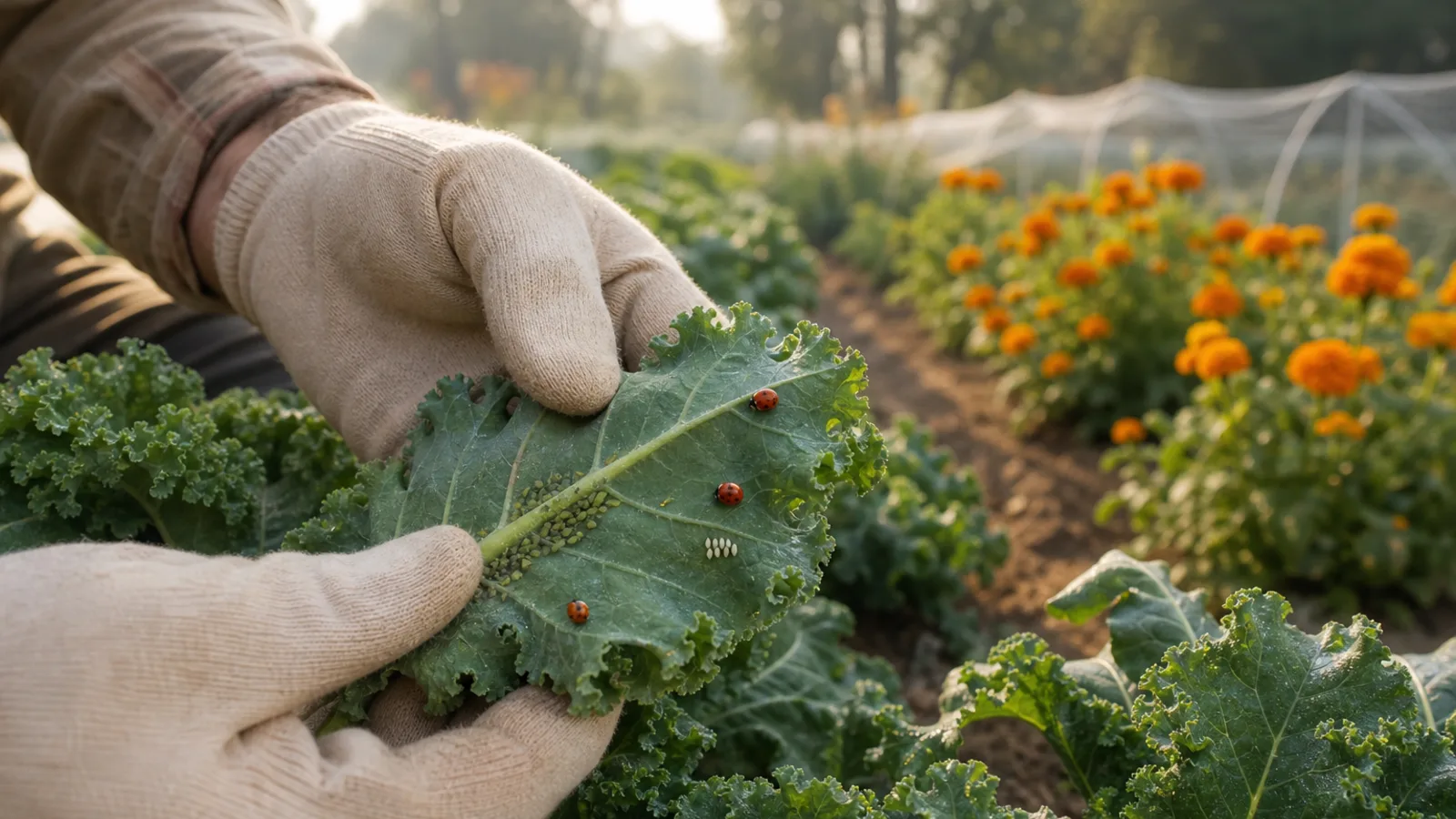
Lady beetles, lacewings, syrphid fly larvae, predatory bugs, ground beetles, spiders, parasitic wasps, birds, and other organisms contribute to pest suppression. Their value depends on arriving at the right time and finding shelter, alternative prey, nectar, pollen, and appropriate habitat.
Plant diverse, adapted flowering species with different bloom periods and flower structures. Protect field edges from unnecessary disturbance. Avoid invasive species and plants that host serious crop diseases or pests. Provide clean water only in ways that do not breed mosquitoes or create contamination risk.
Purchased beneficial organisms can work in certain protected systems, but release is not the same as establishment. Confirm species, temperature, humidity, pest stage, release rate, shipping condition, and compatibility with prior residues. Releasing generalist predators into an unsuitable open field may be expensive and ineffective.
When applying any pesticide, consider direct contact and residues that can harm beneficials. Target location and timing, not merely product choice.
Try mechanical and cultural controls first
Small populations can sometimes be removed by hand, pruned out, vacuumed with suitable equipment, or dislodged with water where the crop and disease risk allow. Trap boards, sticky cards, pheromone traps, and baited traps may monitor or reduce certain pests, but each must be used according to its purpose.
Do not place traps without a plan for reading them. Yellow sticky cards can catch beneficial insects as well as pests, and a trap count may not represent crop damage. Mark locations, check on schedule, and replace when the surface or lure is no longer effective.
Cultivation can expose soil-dwelling stages, while mulch may either suppress or shelter pests depending on the organism. Irrigation timing and airflow influence slugs and foliar disease. Trellising can improve inspection and harvest but may change the crop canopy. The useful control is the one tied to a specific diagnosis.
Understand organic pesticide options
Pesticides include substances used to prevent, destroy, repel, or mitigate pests, even when the ingredient is familiar or naturally derived. Soap, oil, mineral, microbial, botanical, and biological products all have strengths and limits.
Insecticidal soaps require good contact and can injure sensitive plants under certain conditions. Horticultural oils also depend on coverage and timing and may be incompatible with other materials. *Bacillus thuringiensis* products target particular insect groups and work best on susceptible young stages; one strain is not a universal caterpillar control. Spinosad can affect pollinators when misused. Neem-derived materials have specific labels and risks. Diatomaceous earth loses performance when wet and should not be inhaled.
These examples are not recommendations for a particular farm. Before use:
- Confirm the exact pest and crop are on the label.
- Confirm the product is allowed under your certification program if applicable.
- Read rate, timing, personal protective equipment, reentry, preharvest interval, environmental hazards, and maximum applications.
- Calibrate equipment.
- Protect blooms, pollinators, water, workers, and bystanders.
- Record the application.
- Scout again at the labeled interval.
Never use a homemade mixture simply because ingredients are household items. Unlabeled combinations can injure crops, lack efficacy, create residues, and violate pesticide law.
Crop playbook: brassicas
Cabbage worms, loopers, flea beetles, aphids, harlequin bugs, and root pests are common brassica concerns, but pressure varies by region and season.
Begin with rotation, clean transplants, weed-host management, and insect netting installed immediately after planting. Inspect leaf undersides and growing points. Hand-remove caterpillar eggs or larvae in small plantings. Preserve predators and parasitoids; tiny white cocoons near a caterpillar may indicate beneficial activity rather than another pest.
After harvest, remove or incorporate residue according to the disease and rotation plan. Do not allow a failed block to remain a pest nursery beside a new succession.
Crop playbook: cucurbits
Cucumbers, squash, pumpkins, and melons may face beetles, squash bugs, vine borers, aphids, mites, and diseases carried or worsened by insects.
Use resistant varieties where they fit the market, rotate, protect young plants, and inspect stems and leaf undersides. Remove covers when pollination requires it, or use a managed pollination strategy. Trellis suitable crops for airflow and visibility, but anchor systems for fruit weight and wind.
Squash bug eggs are easier to manage before they become mobile nymphs. Wilted vines require diagnosis; water stress, root damage, bacterial disease, and vine borers may look similar from a distance.
Crop playbook: tomatoes and peppers
Tomatoes and peppers may attract hornworms, fruitworms, flea beetles, aphids, whiteflies, mites, and stink bugs. Many serious tomato problems are diseases or physiological disorders rather than insects.
Scout new growth, leaf undersides, fruit, and stems. Stake or trellis for airflow and harvest access. Keep fruit off soil where practical, manage irrigation consistently, and avoid handling wet plants when disease spread is a concern. Remove individual hornworms in smaller plantings, noting that a hornworm covered with parasitoid cocoons is already supporting natural control.
Use sanitation and variety resistance alongside insect management. Killing insects will not correct blossom-end rot, herbicide injury, or a foliar disease.
Crop playbook: greens in protected culture
High tunnels and greenhouses remove rain and wind but can favor aphids, whiteflies, thrips, mites, and fungus gnats. Problems build quickly because conditions are stable and natural enemies may be limited.
Screen openings where ventilation can still function, inspect incoming plants, remove crop debris, control algae, avoid overwatering media, and monitor with carefully placed cards. Check hot spots near doors, heaters, weeds, and older plantings. Separate new starts from production crops when possible.
Biological control can be especially useful in protected culture when planned before populations surge. Work with a knowledgeable supplier to match organisms and environmental conditions.
Respond to an outbreak in the right order
When damage accelerates:
- Mark the affected area and confirm identification.
- Determine whether the problem is localized or widespread.
- Protect clean blocks by changing work order, tools, or traffic.
- Remove severely affected plants if that reduces spread and is agronomically appropriate.
- Review weather, irrigation, fertility, cover, and recent applications.
- Consult a reliable local resource.
- Choose the least disruptive effective action that meets legal and market requirements.
- Schedule follow-up scouting before leaving the field.
Do not stack multiple treatments out of panic. Tank mixes, short intervals, and heat can cause crop injury or unacceptable residues. Know what was already applied.
Measure success beyond dead insects
The goal is a marketable crop and a stable production system, not zero insect life. Evaluate crop damage, packout, treatment cost, labor, beneficial activity, recurrence, and effects on later plantings.
After the season, review which preventive steps worked, where scouting began too late, and which varieties or dates changed pressure. Update the rotation and supply list while the details are fresh. Share a useful observation in the StandFinder community, but include crop, region, timing, and conditions so another grower does not mistake one farm's result for a universal rule.
Build the pest program one crop at a time
Choose a high-value or repeatedly affected crop. Create an identification sheet, scouting route, action threshold, prevention checklist, and list of legal control options. Train everyone who works in that crop to recognize the first signs and record them.
Organic pest control that “actually works” is rarely one clever remedy. It is early information, sound crop management, multiple compatible controls, careful treatment when necessary, and an honest review. That system protects the harvest while preserving the beneficial life that makes next week's control easier.
When you list products in the farmstand marketplace, describe verified growing practices specifically and avoid promising that “organic” means pesticide-free unless that claim is accurate and legally appropriate. Good pest management and good customer communication share the same habit: be precise.