StandFinder Field Notes
Maximizing your farmstand's profitability
Build a healthier farmstand business by understanding costs, setting clear prices, improving the product mix, merchandising effectively, retaining customers, and tracking results.
In this guide · 16 sections
A busy farmstand is not automatically a profitable farmstand. A table can sell out while prices fail to cover labor, or look abundant because too much inventory is headed toward compost. Profitability comes from understanding the full cost of growing and selling, then designing the stand so the right products move through it with less waste and reasonable effort.
The aim is not to squeeze every possible dollar from each visitor. A financially healthy stand can keep quality high, pay people fairly, maintain safe equipment, survive crop failures, and return next season. Clear prices and useful products also create a better customer experience.
Define profit before trying to improve it
Revenue is the total collected. Gross margin subtracts direct product costs. Net profit accounts for the broader cost of operating, including labor and overhead. Cash in the box is not the same as money available to spend.
Separate farmstand performance from whole-farm accounting while keeping them connected. The stand may sell crops grown elsewhere on the farm, use shared vehicles and refrigeration, and occupy hours that could support another market. Give it a fair share of those costs.
Track at least:
- Sales by day and payment type
- Product quantity brought, sold, donated, composted, or returned to storage
- Harvest, wash-pack, stocking, selling, and cleanup labor
- Packaging and payment fees
- Stand-specific utilities, supplies, permits, insurance, and promotion
- Mileage or delivery expense
- Refunds, discounts, and uncollected honor payments
Work with a bookkeeper, accountant, or tax professional for formal financial records. A stand log is a management tool, not a replacement for proper accounting.
Calculate true product cost
Seed cost is usually a small part of a crop's journey. Include bed preparation, fertility, planting, irrigation, weed and pest work, harvest, washing, cooling, grading, packaging, transport, display, selling, and expected loss. Perennial crops also need establishment and maintenance considered over productive years.
Choose a unit customers actually buy: bunch, pint, pound, dozen, bouquet, bag, or piece. Estimate marketable units, not theoretical yield. Divide relevant cost by those units, then add the margin needed to support overhead, risk, and reinvestment.
If a bunch of carrots requires too much wash and bunching time at the accepted price, test options. A different bunch size, topped bulk carrots, a wash-station improvement, better weed control, or a more efficient harvest tool may solve the issue. Simply ignoring labor does not make the crop profitable.
Review cost after the season. Yields, wages, packaging, and loss change. A price copied from last year or a nearby supermarket may have little connection to today's farm.
Use contribution margin to compare products
Contribution margin is the selling price minus variable costs associated with making and selling that unit. It helps show which products contribute most toward fixed costs and profit.
A high-priced product can have a weak contribution if it uses expensive packaging and extensive labor. A low-priced herb bunch may contribute well if harvested efficiently and sold as an add-on. Also consider how quickly the product turns and how much display or cooler space it occupies.
Do not eliminate every low-margin product. Sweet corn, eggs, or a familiar vegetable may draw visits that lead to other purchases. Treat these as anchor products and verify that the total basket justifies their role. A product with poor margin, high waste, and little traffic value needs a different plan.
Build a simple product matrix:
| Product role | Customer value | Farm question |
|---|---|---|
| Anchor | Gives people a reason to stop | Does the full basket cover its lower margin? |
| Core staple | Makes the stand useful every week | Can supply and quality stay reliable? |
| Premium seasonal | Offers distinction and higher value | Is labor and loss controlled? |
| Add-on | Completes a meal or gift | Is it visible and easy to choose? |
| Experimental | Tests a new opportunity | What result will justify another season? |
Set prices with a method
Start from cost and required margin, then compare with local direct-market prices, product quality, pack size, season, and convenience. A farmstand does not need to be the cheapest option. It needs to make the value understandable.
Use consistent units and clear signs. Hidden prices slow purchases and make customers worry they are being treated differently. If selling by weight, use an approved scale and follow local weights-and-measures rules.
Avoid discounting fresh product reflexively late in the day. Customers may learn to wait, and the discount may still fail to cover labor. Instead, plan smaller display quantities, take preorders, use bundles, adjust pack sizes, process products through a legal channel, donate through a managed partnership, or plant less.
Review prices on a schedule rather than in the middle of a rush. Document why they changed. Train everyone at checkout so the same product receives the same price.
Build a product mix around customer missions
People stop for a reason: tonight's dinner, weekly basics, preserving quantities, a host gift, a special flavor, or a family outing. Merchandise products that help complete those missions.
A tomato anchor can be supported by basil, garlic, onions, peppers, and a salsa or sauce recipe. A breakfast group may include eggs, bread, jam, fruit, and honey where each product is legal and correctly sourced. A holiday table can combine storage crops, preserves, dried herbs, and bouquets or greenery.
Bundles reduce decision effort, but calculate their margin. Use sound products, not a mix designed to conceal old inventory. Offer a range of entry prices so a visitor can buy one bunch without feeling the stand is only for large baskets.
Limit variety where choice becomes confusing or production becomes inefficient. Three well-differentiated tomato choices may sell better than twelve poorly labeled ones. Add a fourth when customers can understand why it belongs.
Reduce shrink before chasing more traffic
Shrink includes spoilage, damage, theft, inaccurate counts, overfilling, sampling, and products that lose marketability. It is often one of the fastest profitability opportunities because the crop has already absorbed its production cost.
Record the fate of unsold inventory. “Leftovers” is too vague. Was it safely stored and sold later, donated, fed to animals appropriately, processed, composted, or discarded? Which product, quantity, and reason?
Common corrections include:
- Harvesting closer to demand
- Cooling promptly with crop-appropriate methods
- Keeping displays shaded and replenishing from storage
- Using containers that prevent crushing
- Standardizing bunch and pack size
- Training staff to rotate inventory
- Removing damaged items before they affect neighbors
- Publishing sold-out updates so customers do not make unnecessary trips
An abundant display does not require every unit on the table. Use stable crates and false bottoms to create height, then restock.
Merchandise for speed and confidence
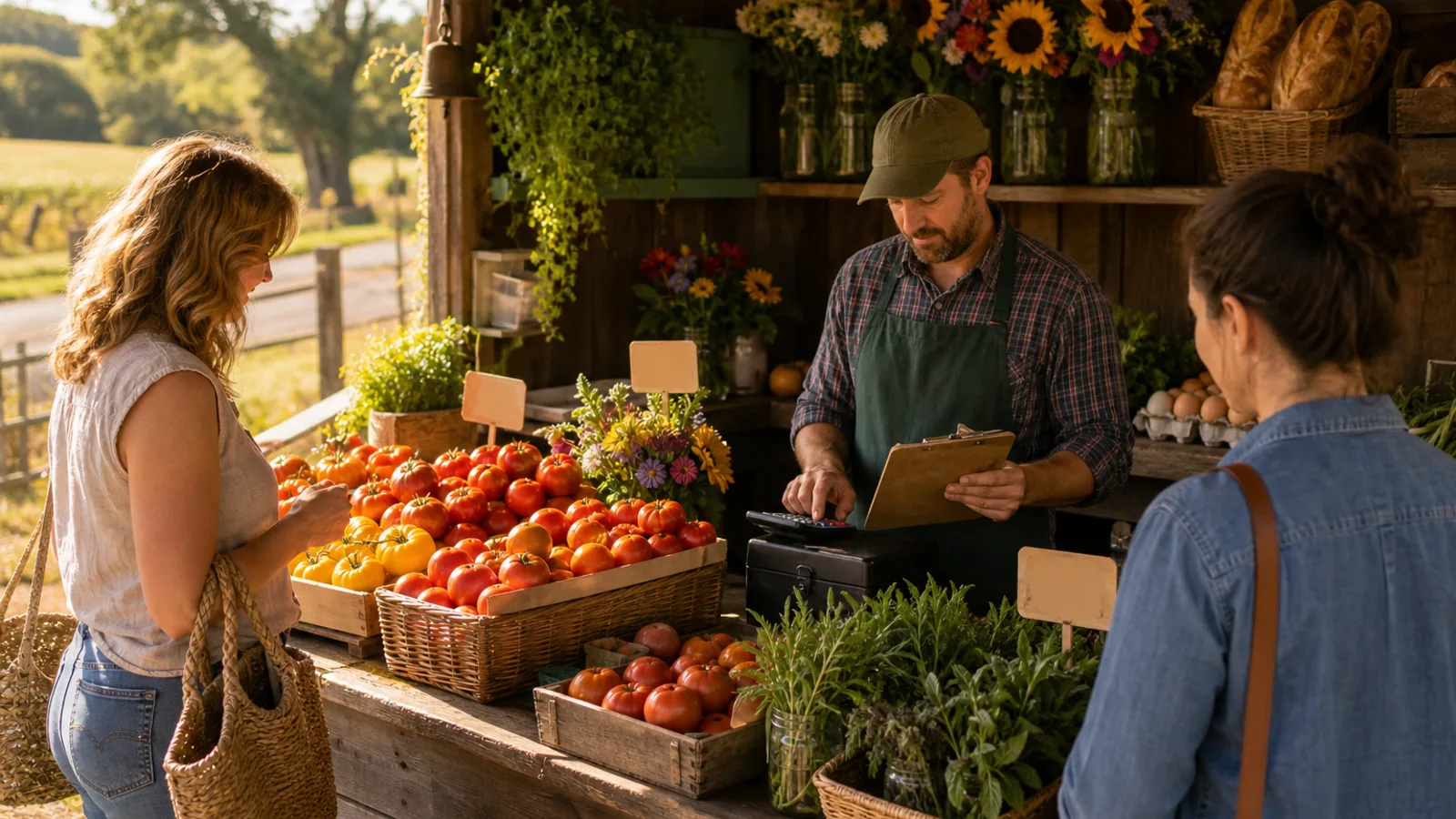
The display should guide a new shopper without a tour. Put an anchor item in the strongest visual position, group related products, keep labels with the correct item, and create a clear checkout path.
Every sign should answer a decision: product name, price, unit, source when needed, and perhaps one preparation or storage tip. Avoid dense paragraphs at the table. Move the farm story and longer guides to a separate board or QR link.
Good lighting, shade, cleanliness, and full-looking small containers improve perceived care. Remove empty boxes and wilted leaves. Keep personal items, cleaning supplies, and back stock out of the customer zone.
Watch behavior for ten minutes. Where do people stop? Which product do they pick up and return? What do they ask? A display change based on observation can outperform new advertising.
Increase basket size by being useful
Upselling should solve a customer's problem, not pressure them. Ask a relevant question: “Are you making sauce?” or “Would you like basil with those tomatoes?” Let the answer end the conversation.
Offer logical add-ons at checkout and place complements together. Small herb bunches, garlic, recipe cards, flowers, or a storage guide can increase value. Prepacked quantities for canning or freezing serve customers who want volume and reduce transaction time, but require clear ordering, pickup, and cancellation terms.
Test one offer at a time. Compare average transaction, product margin, waste, and checkout speed. A bundle that raises sales but causes packing labor and leftovers may not improve profit.
Choose hours from sales per labor hour
Track transactions and sales by hour alongside staffing, setup, and closing time. A four-hour opening may actually require seven labor hours. An honor period may reduce staffing but add restocking, reconciliation, loss, and security work.
Identify strong windows and communicate them consistently. A short evening opening for commuters might add sales without occupying an entire day. A slow midweek period may be better used for preorder pickup.
Do not change hours every week. Gather enough observations to separate a pattern from weather or one event. Then announce the new schedule everywhere before it starts.
Make payment easy without ignoring fees
Cash, cards, contactless payments, online preorders, and honor boxes each have costs and benefits. Compare transaction fees, hardware, connectivity, bookkeeping, dispute risk, cash handling, and customer preference.
Set up the system before traffic arrives. Keep devices charged, updated, and secured. Reconcile payment totals with recorded sales and inventory. Limit cash held on site and use safe procedures for deposits.
If minimum purchase amounts or convenience fees are considered, confirm card-network, platform, and local requirements and communicate clearly. A confusing payment rule can cost more goodwill than the fee it avoids.
Online preorders can stabilize demand for high-risk or limited products. Set inventory caps, pickup windows, substitution rules, and reminders. Do not sell quantities the field cannot reasonably supply without a communication plan for crop failure.
Retain customers before paying to acquire more
The least expensive future visit often comes from someone who already trusts the stand. Reliability, quality, accurate hours, and respectful service are the retention program.
Keep a current StandFinder grower listing with location, entrance details, hours, payment methods, photos, and seasonal products. Update availability without claiming exact stock when the stand can sell out quickly.
Offer an email or text harvest note only through explicit opt-in. Send concise, useful information: what is ready, when the stand opens, preorder deadlines, and unexpected closures. Make leaving the list easy. Track visits or orders generated, not just subscriber count.
Loyalty offers can work, but calculate the cost and administrative burden. A simple seasonal thank-you or preorder priority may fit a small stand better than a complicated points program.
Use promotions that can be measured
Before running a paid placement, flyer, event, or giveaway, define the target action: directions, first purchase, preorder, or return visit. Use a specific link, code, question at checkout, or date comparison to learn what happened.
Do not evaluate promotion on reach alone. Measure contribution after product cost, discount, fee, and extra labor. Note whether new customers returned without another incentive.
Collaborations can share attention. Pair with a complementary local producer or organization whose audience, quality, and operating practices fit. Put inventory, payment, source labeling, and promotion responsibilities in writing.
Create a one-page weekly dashboard
A useful dashboard can fit on one sheet:
- Total sales
- Transactions and average transaction
- Sales and contribution by key product
- Product shrink by reason
- Selling and support labor hours
- Sales per open hour and per labor hour
- Payment fees and discounts
- Top requests and sold-out items
- Weather, closure, or event notes
Compare with the prior weeks and the same period last season when available. Look for causes, not just changes. Higher average transaction may come from price increases rather than more items. Lower waste may come from selling out too early and losing profitable sales.
Keep experiments in a separate line. Note the display, bundle, hour, or message tested and the expected result.
Run a four-week profit improvement sprint
Week one: establish truth. Count inventory in and out, log all stand labor, list payment and packaging fees, and calculate rough unit cost for five major products.
Week two: fix visible waste. Improve shade, cooling, pack size, display quantity, or harvest timing for the product with the largest loss. Do not add promotion yet.
Week three: improve one customer decision. Clarify a price, group complements, test one bundle, or add a useful product note. Observe behavior and compare the result.
Week four: adjust one operating choice. Evaluate a slow hour, payment method, stocking interval, or preorder option. Review the full month with both financial and workload measures.
Repeat with the next constraint. Small changes compound when the records remain consistent.
Protect trust while improving margin
Never let profitability experiments blur source, quality, pack size, or availability. Label partner products. Cull unsafe or spoiled food. Do not invent scarcity, inflate “regular” prices, or hide fees. Avoid health claims and sustainability claims you cannot verify.
Train staff to handle complaints and refunds consistently. A fair correction can preserve a relationship worth far more than one transaction. Track repeated complaints because they may reveal a production or communication problem.
A healthier stand supports a healthier farm
Profit improvement is not one price increase or viral post. It is a cycle: know costs, choose the product's role, price clearly, protect quality, make shopping easy, reduce waste, keep useful hours, retain trust, and review the evidence.
Browse the farmstand marketplace to understand how other local sellers present products without copying prices blindly. Share operational lessons in the StandFinder community. The best result is a stand customers value and a business the grower can afford to open again.