StandFinder Field Notes
Heirloom vs. hybrid seeds: making the right choice
Compare heirloom and hybrid seed varieties by flavor, predictability, disease resistance, seed-saving potential, customer appeal, and fit for your growing conditions.
In this guide · 16 sections
The choice between heirloom and hybrid seed is often framed as tradition versus technology. That makes a lively label, but it is not a useful crop plan. Growers need to know whether a variety will germinate, tolerate local pressure, mature in the available season, meet the customer promise, and earn its place in the field.
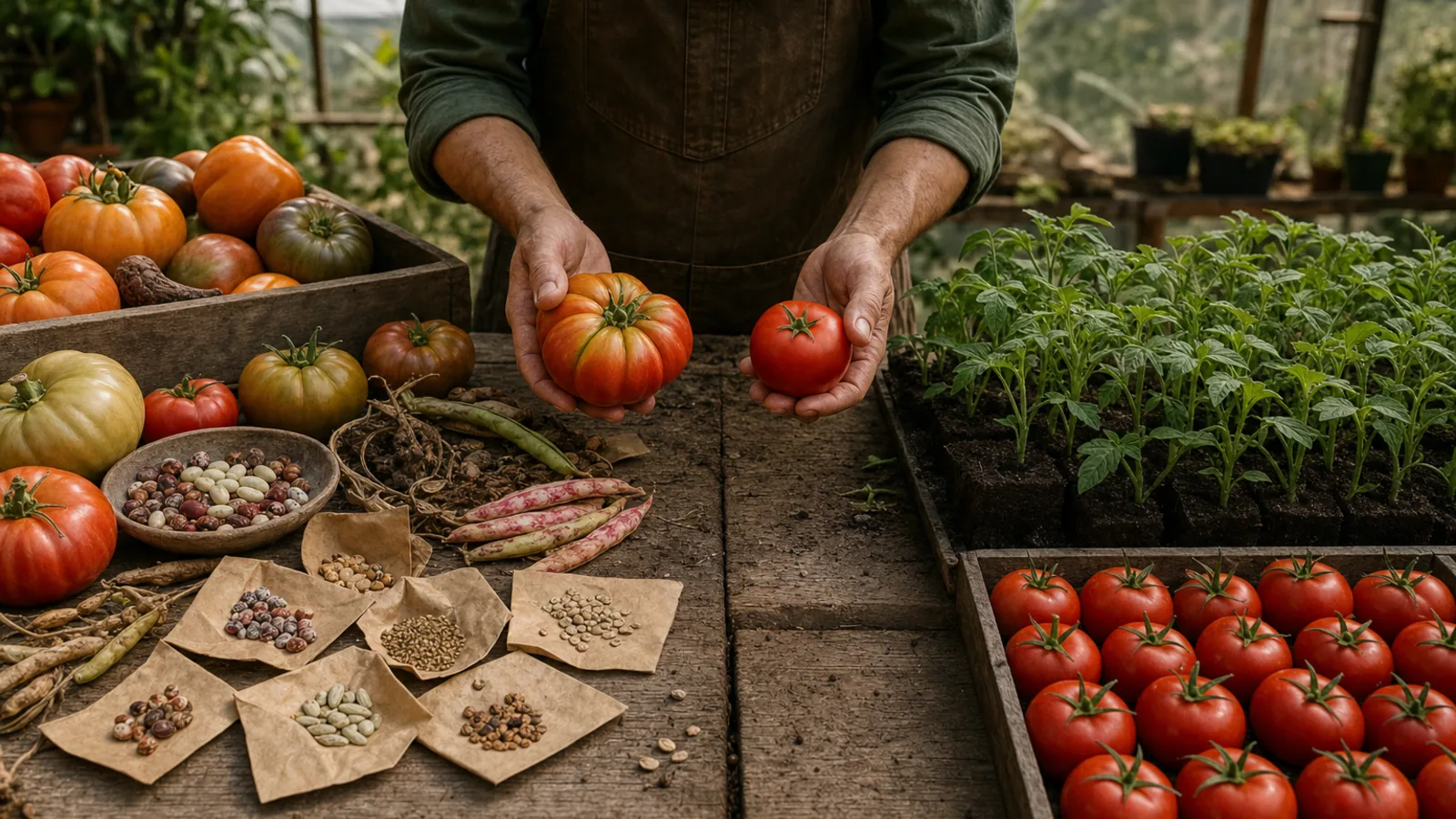
Heirlooms can deliver distinctive flavor, appearance, history, and seed-saving potential. Hybrids can offer uniformity, vigor, resistance, and concentrated timing. Either can succeed or fail. Many farms profit from both.
Understand the terms first
An open-pollinated variety generally produces offspring similar to the parent population when it is allowed to pollinate within the variety and is kept adequately isolated from compatible varieties. Natural variation still exists, and selection by the seed saver influences the population.
An heirloom is an open-pollinated variety associated with historical continuity, a community, family, place, or period. There is no single universal age rule. The value may include flavor and cultural history, but the word does not guarantee disease resistance, local adaptation, or superior quality.
An F1 hybrid is the first generation produced by crossing selected parent lines. Seed from an F1 plant can grow, but the next generation usually separates into varied traits rather than reliably reproducing the original hybrid. To grow the same F1 again, farmers ordinarily purchase new seed.
These categories do not tell you whether seed is organic, untreated, conventionally treated, genetically engineered, or produced in a particular country. Read the supplier's description and documentation instead of treating unrelated labels as synonyms.
Begin with the job the crop must do
Before comparing catalogs, write the requirements:
- Target harvest window and number of harvests
- Field, tunnel, container, or greenhouse environment
- Known disease, insect, and weather pressure
- Desired size, color, flavor, texture, and shelf life
- Harvest and grading labor available
- Farmstand, restaurant, wholesale, processing, or storage market
- Seed-saving goal, if any
- Price customers will accept and yield needed at that price
A cherry tomato for a mixed-color farmstand pint has a different job from one packed for wholesale. A winter squash sold for its story may tolerate more size variation than one fitting standard produce boxes.
Variety descriptions are starting points. Local trials and records decide whether the claims translate to your soil and management.
Compare flavor without relying on reputation
Many celebrated heirlooms have complex flavor, tender texture, and visual character. Those traits can create a memorable tasting and a premium direct-market product. But variety name alone does not determine flavor. Ripeness, water, fertility, temperature, plant health, harvest timing, and storage all influence the result.
Some hybrids are bred for flavor as well as resistance or shipping. Others prioritize uniformity and shelf life. Do not assume all hybrids taste alike or all heirlooms taste excellent.
Run a blind tasting at the same ripeness. Include customers, staff, and the intended buyer. Record sweetness, acidity, aroma, texture, appearance, and how the product performs after a day or two in normal handling. A variety that wins in the field but collapses on the farmstand table may not serve the operation.
Value uniformity where it saves real work
Uniform germination, plant habit, maturity, and fruit size can simplify seeding, cultivation, harvest, packing, and pricing. Concentrated maturity may help a processing order or wholesale delivery. Predictable head size may fit a standard box.
Uniformity is not always beneficial. A concentrated harvest can overwhelm a small crew or produce more than a weekend stand can sell. A diverse appearance can be an asset in a mixed display. Indeterminate harvest may support a long direct-market season.
Calculate the operational effect. Did the hybrid reduce grading time? Did the heirloom's varied shapes attract customers but increase culls? Did a uniform crop create a peak that required extra labor? Measure the entire workflow.
Treat disease resistance as specific information
Hybrid catalogs often highlight resistance packages, but open-pollinated varieties can also carry useful resistance or tolerance. Resistance is specific to named diseases, pathogens, or races and may not prevent infection entirely.
Learn the abbreviations in the catalog and verify them with the supplier. Match resistance to problems confirmed on your farm or likely in your region. Do not choose a long list of letters at the expense of essential market or maturity traits.
Resistance supports integrated pest management; it does not replace rotation, sanitation, airflow, irrigation management, healthy transplants, scouting, or appropriate controls. Pathogen populations can change, and plants can still suffer from disorders that resemble disease.
If a crop repeatedly fails, obtain a diagnosis before selecting the next variety. “Wilt resistance” is not useful if the real problem is root damage, waterlogging, or a different wilt.
Consider vigor, stress, and climate fit
F1 hybrids may show hybrid vigor, expressed as strong growth, yield, or uniformity under particular conditions. That does not mean every hybrid tolerates every stress. An heirloom maintained in a region may be well adapted to its climate, while a famous heirloom from elsewhere may struggle.
Compare days to maturity, heat or cold response, day-length sensitivity, plant habit, rootstock compatibility where relevant, bolting, cracking, lodging, and storage behavior. Read trial reports from comparable climates, not only national rankings.
Your farm has microclimates. Trial a variety in the field or tunnel where it would actually grow. Irrigation, trellis, fertility, and pruning should resemble normal management. A pampered six-plant test may not predict a production block.
Understand the economics of seed price
Hybrid seed often costs more per seed because maintaining parent lines and producing the cross requires specialized work. Some heirloom seed is inexpensive; rare or carefully maintained stock may also be costly.
Seed price matters, but compare it with total crop cost and marketable yield. If a more expensive cabbage seed produces uniform heads and reduces empty harvest trips, the seed difference may be small. If a costly hybrid does not improve packout, timing, or price, the premium may not return value.
Calculate:
- Usable plants after germination and transplant loss
- Marketable units per plant or bed
- Labor for harvest and grading
- Packaging and storage loss
- Selling price and sell-through
- Seed cost per marketable unit
For transplanted crops, high germination and uniform seedlings can also save greenhouse space and labor. For direct-seeded crops planted thickly, seed cost per row may matter more.
Decide whether seed saving is a real goal
Saving seed can preserve a valued variety, adapt a population over time, reduce some purchases, and connect a farm to cultural history. It is also skilled production. Seed crops require correct identification, population size, isolation, rogueing, maturity, harvest, cleaning, drying, storage, germination testing, and records.
Self-pollinating crops such as beans, peas, lettuce, and tomatoes are often approachable, though crossing still occurs. Wind- or insect-pollinated crops may require greater isolation or controlled pollination. Biennials must survive or be stored through winter before flowering.
Do not save seed from an F1 hybrid expecting the next generation to remain uniform. The result may be interesting for breeding but is not a reliable substitute for buying the same hybrid.
Check intellectual-property restrictions, contracts, patents, and licenses before saving, propagating, sharing, or selling seed. “Open-pollinated” does not automatically answer every legal question. Also prevent seedborne disease by using clean stock and crop-specific sanitation or testing guidance.
Protect the story behind an heirloom
An heirloom's name may carry a family, Indigenous community, immigrant history, breeder, or region. Learn from reputable sources and avoid inventing a romantic story to increase sales.
When a variety was shared personally, ask how the steward wants it named, credited, or distributed. Some seeds carry cultural responsibilities that are not captured by commercial availability. Acknowledge uncertainty when the history is disputed.
At the farmstand, one short accurate card can make the product memorable: where the variety came from, what it tastes like, and how to use it. Do not imply that age alone makes it nutritionally superior or environmentally preferable.
Use hybrids where reliability protects the whole mix
A dependable hybrid can stabilize the stand while riskier varieties add distinction. For example, a disease-resistant slicing tomato may provide weekly volume, while several heirlooms supply tasting colors and premium singles. Uniform carrots may fill standard bunches while an open-pollinated specialty variety is sold for roasting.
This portfolio approach reduces the chance that one weakness empties the display. It also gives customers a choice without asking the farm to carry ten versions of every crop.
Assign each variety a role: dependable volume, earliest harvest, heat-set insurance, storage, flavor feature, unusual color, seed preservation, or processing. If two varieties fill the same role, compare them directly and remove the weaker one unless diversity itself provides risk protection.
Build a fair on-farm trial
Choose a small number of candidates and include the current standard. Plant enough to observe variation. Use the same seeding date, healthy transplants, bed preparation, spacing, irrigation, and crop care unless the trial is explicitly testing a management difference.
Randomize or repeat sections when field variability could distort the result. At minimum, avoid placing every new variety at the wet end and the standard at the well-drained end.
Record:
- Supplier, lot, seed treatment, and cost
- Germination and usable transplants
- Plant vigor and uniformity
- First, peak, and final harvest
- Marketable yield and cull reasons
- Disease, pest, cracking, bolting, and weather response
- Harvest and grading time
- Flavor, storage, and customer response
- Revenue and contribution after major variable costs
Photograph the crop at the same stages. Keep the variety names hidden during customer tastings when possible.
Compare crop by crop
Tomatoes: Heirlooms may bring flavor, color, and premium appeal but can be prone to cracking, uneven shape, disease, or short shelf life. Hybrids may add resistance, firmness, yield, and uniformity. Plant habit and maturity matter as much as category.
Sweet corn: Many growers use hybrids for sweetness type, uniform maturity, and disease traits. Isolation among sweetness types and planting schedules can affect quality. Select with local guidance and understand harvest timing.
Winter squash and pumpkins: Hybrid uniformity can support bin, box, or display needs. Open-pollinated varieties offer distinctive eating quality and seed-saving potential. Vine vigor, disease, curing, and storage determine profitability.
Lettuce and greens: Bolting, tipburn, disease resistance, color, leaf strength, and regrowth affect the choice. An open-pollinated lettuce can be highly uniform; a hybrid is not automatically required.
Beans and peas: Open-pollinated varieties are widely available and often straightforward for seed saving. Compare concentrated set, picking ease, stringlessness, heat response, flavor, and disease pressure.
Brassicas: Hybrids often provide uniform maturity and resistance packages valued in commercial production. Open-pollinated options can fit extended harvest or seed work. Head quality and timing should match labor and market.
Help shoppers understand the difference
Label variety names and useful traits, not just “heirloom” or “hybrid.” Tell customers whether a tomato is tart, sweet, meaty, tender, good for sandwiches, or best for sauce. Explain that both categories can be grown with careful practices.
A side-by-side tasting creates a better conversation than declaring a winner. Ask what the customer plans to cook. The best choice for a Caprese salad may not be the best for a canning day or a week on the counter.
Avoid using “hybrid” as if it means genetically engineered, chemically grown, or flavorless. Avoid using “heirloom” as proof of organic production, sustainability, or superior nutrition. Accurate education builds more trust than a simplistic hierarchy.
Create a decision scorecard
Weight the traits that matter to the crop's job. A direct-market tomato scorecard might give high weight to flavor and customer appeal, moderate weight to marketable yield and cracking, and lower weight to perfect uniformity. A wholesale cabbage scorecard may reverse those weights.
Score each variety only after the season, then add a confidence note. One unusually mild year produces weak evidence about disease resistance. Keep seed for a second trial when the first result is promising but inconclusive.
Review the entire set. The highest individual score may not be the best addition if another variety already fills the same window. Select a crop portfolio, not a catalog trophy case.
Buy seed with traceability
Use suppliers that provide clear variety, lot, germination, treatment, and production information. Order early enough to obtain backups without panic substitutions. Store seed cool, dry, dark, pest-free, and labeled. Protect original lot information when repacking for field use.
Test older seed before relying on it. Adjust seeding only with an understanding of germination and seedling vigor; doubling weak seed may create a crowded, uneven tray rather than a good stand.
If you produce seed for sale, additional labeling, testing, licensing, and plant-health rules may apply. Verify them before offering packets at a farmstand.
Choose both when both serve the farm
The heirloom-versus-hybrid decision does not need one winner. Use a hybrid when resistance, maturity, or packout prevents a costly gap. Use an heirloom or other open-pollinated variety when flavor, story, adaptation, or seed stewardship creates value. Stop growing either one when it repeatedly fails the job.
Share trial details—not just favorites—with growers in the StandFinder community. When listing seasonal products in the marketplace, name the variety and describe its eating qualities. Customers rarely need an argument about seed categories. They need a good product, an honest story, and a reason to look forward to its return.