StandFinder Field Notes
Composting 101: turning waste into gold
Turn crop residue and other organic material into a useful soil amendment by balancing compost ingredients, moisture, air, temperature, time, and careful pile management.
In this guide · 17 sections
Compost turns plant residues and other appropriate organic materials into a stable soil amendment through the work of microorganisms, moisture, oxygen, and time. A well-managed pile can reduce disposal, return organic matter to the soil, and create a useful material for beds and fields.
It is not magic and it is not a place for everything biodegradable. Poorly managed piles can smell, attract animals, spread weeds or pathogens, create runoff, and consume more labor than the finished material is worth. The goal is a controlled decomposition system that fits the site's space, feedstocks, equipment, and intended use.
Know what finished compost can and cannot do
Mature compost can improve soil structure, water handling, biological activity, and the soil's ability to hold nutrients. It supplies nutrients, but its analysis varies and often does not match a crop's complete fertility need. Treat it as both an amendment and a nutrient source that deserves testing and an application plan.
Compost does not instantly fix severe compaction, drainage, contamination, salinity, or an unsuitable pH. It cannot replace crop rotation, living roots, erosion control, or careful nutrient management. Excess application may add more phosphorus, salts, or other constituents than the soil needs.
Decide the purpose before building the pile. Home-garden compost, potting-mix ingredients, certified-organic farm use, and material applied near food crops may have different quality and regulatory expectations.
Choose a safe, workable site
Place the system where materials and equipment can reach it in wet and dry weather. Leave space to build, turn, monitor, cure, screen, and store finished compost without mixing stages.
The site should protect surface water, wells, neighbors, and production areas. Avoid flood-prone ground and uncontrolled runoff. Provide a suitable base that supports equipment and allows drainage management without allowing contaminated liquid to leave the site.
Consider:
- Distance from homes, roads, property lines, and sensitive areas
- Prevailing wind
- Access to water for moisture adjustment
- Shade and sun
- Equipment turning radius
- Fire access and pile-size limits
- Storage for dry carbon materials
- Barriers against livestock, wildlife, pets, and unauthorized visitors
Local zoning, environmental, agricultural, solid-waste, fire, and food-safety rules may apply, especially to larger systems or imported material. Verify requirements before accepting feedstocks.
Understand greens and browns
Compost organisms need carbon for energy and nitrogen to build proteins. Growers often call nitrogen-rich materials “greens” and carbon-rich materials “browns.” The names describe function more than color.
Common greens include fresh crop residue, grass clippings from known sources, coffee grounds, fresh weeds without mature seed, and manure where appropriate. Common browns include dry leaves, straw, shredded plain cardboard, dry stalks, and wood chips or sawdust used in suitable proportions.
Materials vary widely. Dry poultry litter and lush grass are not equivalent greens; sawdust and straw do not decompose at the same speed. A practical pile uses a diverse mix and is adjusted by observation rather than by color alone.
A common starting habit is to combine roughly two or three loose volumes of brown material with one loose volume of green material. Volume is only a field estimate. Dense, wet, or unusually high-nitrogen materials may require much more carbon. Use temperature, odor, moisture, and structure to refine the blend.
Exclude risky or unsuitable materials
Do not add materials simply because they can decompose. Household meat, dairy, fats, cooked foods, pet waste, treated wood, glossy or plastic-coated paper, synthetic materials, chemicals, coal ash, and unknown residues can create pests, contamination, odor, or legal problems in a basic farm or garden pile.
Be careful with:
- Plants treated with persistent herbicides
- Manure or bedding from animals fed treated forage
- Diseased crops that the process may not reliably sanitize
- Invasive plants and mature weed seed
- Produce stickers, plastic twine, mesh, and coated packaging
- Roadside leaves or grass with unknown contamination
- Large woody material that will not break down on the intended timeline
Ask suppliers about source and treatment history. A small contaminated input can affect a large volume of compost and sensitive crops. When uncertain, exclude it or obtain qualified guidance and testing.
Prepare materials for efficient decomposition
Smaller pieces provide more surface area, but shredding everything into paste removes air spaces and adds labor. Chop bulky stalks, break up matted grass, and mix fine materials with coarse structure.
Store dry browns under cover so they are available when a wet, nitrogen-rich load arrives. Without a carbon reserve, the pile may become an anaerobic odor problem before it can be balanced.
Remove contaminants during collection, not after curing. Plastic fragments become harder to see and nearly impossible to retrieve after repeated turning. Label bins and train everyone contributing material.
Estimate the volume of feedstocks over a week or season. A system sized for occasional garden scraps may be overwhelmed by a wash-pack cull stream. Reduce avoidable food loss before designing compost around it.
Build a pile with enough mass and structure
A pile needs enough volume to retain heat but not so much that the center cannot receive air. A roughly cubic yard is a common beginner scale for active compost, though climate, material, bins, and management change performance.
Build by blending materials throughout rather than creating thick, separate layers. Aim for a mix that holds its shape loosely, contains both fine food for microbes and coarse air spaces, and feels moist throughout.
As you build:
- Start with a base that allows air and drainage without becoming a rodent shelter.
- Mix greens and browns in manageable batches.
- Break apart clumps.
- Moisten dry material as it enters.
- Cover with a breathable or managed cover appropriate to local rain and drying.
- Label the pile with start date and major feedstocks.
Avoid continually adding small amounts to a pile you expect to finish on a schedule. Batch systems make heating, curing, and traceability easier. Keep a separate collection or new pile for fresh material.
Manage moisture by feel and measurement
Microbes need water, but saturated pores lose oxygen. A practical target is material that feels like a wrung-out sponge: evenly damp, with perhaps a drop when squeezed, not streaming.
Check multiple depths. The outside may be dry while the center is wet. Add water during turning so it distributes through the mix. If the pile is waterlogged, combine it with dry, absorbent carbon and improve cover or drainage.
Rain can saturate an uncovered pile and carry nutrients away. An impermeable cover can also trap condensation or prevent airflow if poorly managed. Choose a cover system that matches climate and monitor underneath it.
Document major water additions. Repeated drying may indicate a pile that is too small, exposed, coarse, or frequently turned.
Keep oxygen in the process
Fresh, earthy composting is primarily aerobic. Sour, rotten-egg, or sewage-like odors often signal low oxygen, excess moisture, or too much readily available nitrogen.
Turning rebuilds pore space, redistributes moisture and heat, and moves outer material into the active zone. The ideal schedule depends on the method. A frequently turned hot pile may finish active decomposition quickly but demands labor and equipment. A passive pile takes longer and may not heat uniformly.
Do not turn only by the calendar. Use temperature, odor, settling, moisture, and the process goal. If the pile is hot and well structured, unnecessary daily turning can release heat and moisture. If it is cooling because oxygen is depleted, turning may restart activity.
Passive aeration pipes and coarse bulking material can help in some systems, but they do not correct a saturated, poorly balanced mass.
Monitor temperature safely
A long compost thermometer lets you track the center without reaching into hot material. Measure at several locations and depths at a consistent time. Record the highest and representative temperatures.
Heating shows microbial activity, not automatic safety or maturity. Very high temperatures can reduce beneficial activity, dry the pile, create fire risk, and still leave cool pockets. A pile that never heats may be too small, dry, low in nitrogen, cold, or already partly decomposed.
If the process is intended to reduce pathogens or weed seed, follow the applicable validated time-and-temperature standard, pile dimensions, turning schedule, monitoring locations, and recordkeeping for the farm and intended use. One hot thermometer reading does not prove the whole pile was treated.
Organic certification and produce-safety requirements can distinguish between treated compost, untreated biological soil amendments of animal origin, and other materials. Obtain current guidance for your operation.
Troubleshoot with the pile's signals
| Symptom | Likely causes | First checks |
|---|---|---|
| Rotten or sour odor | Too wet, compacted, excess nitrogen | Moisture at depth, clumps, air space, feedstock mix |
| Ammonia odor | Excess available nitrogen or high pH | Add dry carbon and remix; review manure or grass quantity |
| Pile stays cool | Too small, dry, low nitrogen, cold, or finished | Size, moisture, mix, recent temperature pattern |
| Pile heats then stops | Moisture or oxygen depleted; easy food consumed | Turn and inspect before adding material |
| Flies or animals | Exposed food, unsuitable inputs, gaps | Bury approved feedstock, cap with browns, secure bin |
| Materials remain recognizable | Pieces too large, dry, woody, or process incomplete | Chop, moisten, remix, and allow more time |
| Slimy mat | Fine wet grass or leaves compacted | Break apart and mix with coarse dry carbon |
Change one major variable when possible, then observe. Adding lime, fertilizer, or a commercial activator rarely solves a pile whose real problem is air, moisture, balance, or size.
Choose a method that fits the operation
Turned piles or windrows offer active control and can process larger volumes, but require space, labor, equipment, and runoff planning.
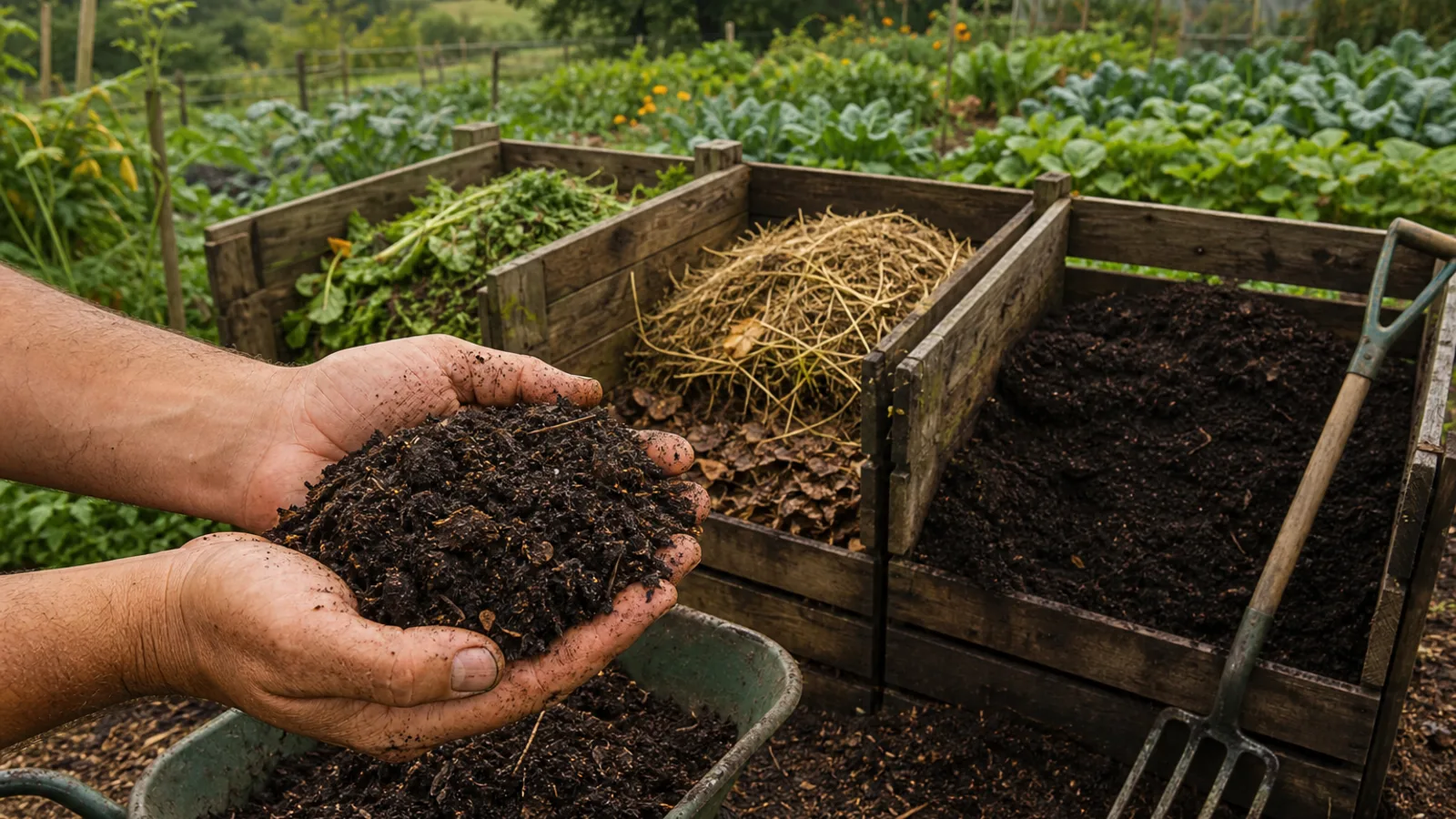
Three-bin systems make it easy to separate collecting, active, and curing stages for a garden or small farm. Bins must still allow access, airflow, and pest control.
Static aerated systems use passive or forced air and can reduce turning, but need careful design and monitoring.
Tumbler systems contain material and turn easily at small scale. Their limited volume may not retain heat, and wet food scraps can become dense without enough dry structure.
Vermicomposting uses composting worms to process suitable material under moderate conditions. It is not a hot process and needs protection from temperature extremes, flooding, and unsuitable feedstocks.
Choose based on volume, climate, labor, equipment, sanitation goal, and how the finished material will be used.
Handle manure with extra care
Manure contributes nitrogen and organic material, but source, bedding, diet, veterinary treatments, pathogens, salts, and herbicide residues matter. Keep records of the supplier and animal type. Prevent raw manure runoff and follow applicable rules for storage and application around food crops.
Hot composting manure requires a controlled process, not merely mixing it into a warm pile. If the system does not meet the relevant treatment standard, manage the material according to rules for untreated manure or other biological amendments.
Test finished manure-based compost for nutrients, salts, maturity, and other parameters appropriate to the source and use. Trial it on sensitive plants before broad application when persistent herbicide contamination is a concern.
Recognize when active composting is finished
An active pile eventually stops reheating after turning, shrinks, darkens, and smells earthy. Original ingredients become difficult to recognize except for slow woody pieces. That indicates active decomposition has slowed, but curing still matters.
Move the material to a protected curing area and leave it undisturbed except for moisture management. During curing, remaining compounds stabilize and microbial communities change. Immature compost can compete for nitrogen, harm seedlings, smell, or continue heating after application.
Simple maturity observations include stable temperature near ambient, earthy odor, stable volume, and a crumbly texture. A germination test using a sensitive crop can flag problems, but professional laboratory testing gives better information for commercial or high-risk uses.
Screen only if the end use requires it. Oversized woody pieces can return to a new pile as bulking material, provided they are clean and appropriate.
Test and apply compost deliberately
A compost analysis may include moisture, organic matter, carbon-to-nitrogen ratio, pH, soluble salts, nutrient content, stability or maturity indicators, and contaminants relevant to the feedstock. Pair it with a soil test and crop plan.
Calculate application by area and depth rather than saying “one layer.” A thin-looking application across an acre can represent a large volume and nutrient load. Calibrate spreaders and record field, date, source, analysis, and rate.
Common uses include incorporation before planting, surface application in perennial systems, potting-mix components formulated with appropriate testing, and topdressing. Avoid piling compost against plant crowns or using immature material around seedlings.
More compost is not always better. Watch soil phosphorus, potassium, salts, pH, and nutrient balance over repeated applications.
Connect composting to waste prevention
The most sustainable cull is often the one that was not overproduced or damaged. Track why material enters the pile: field loss, grading, poor cooling, expired display, customer handling, or unavoidable residue.
Improve harvest forecasting, cold chain, pack size, display quantity, donation timing, and sales communication before accepting compost as the automatic destination. Compost remains valuable for truly unavoidable organic material, but it should not hide a farmstand inventory problem.
Keep plastics, rubber bands, produce stickers, twist ties, and synthetic netting out of the cull stream. Place a clearly labeled contamination bin near sorting.
Scale only after one repeatable batch
For a first system, build one documented batch. Record ingredients, approximate volumes, dates, moisture changes, temperatures, turns, odors, problems, curing time, and final volume. Use or test the finished product before doubling intake.
Scaling changes aeration, equipment, fire risk, runoff, permits, neighbor impact, and traceability. Imported food scraps can introduce packaging and regulatory responsibilities. Make sure the value of finished compost and avoided disposal justifies collection and labor.
Compost is managed decomposition
Good composting is a sequence: prevent avoidable waste, choose clean feedstocks, balance carbon and nitrogen, maintain moisture and air, monitor temperature, cure fully, test when appropriate, and apply according to soil need. Every step protects the value created by the one before it.
Use the finished material as part of a broader sustainable farming plan, and compare practical systems with growers in the StandFinder community. When compost is managed as a farm input rather than a mysterious waste heap, “turning waste into gold” becomes less of a slogan and more of a measurable soil-building practice.